
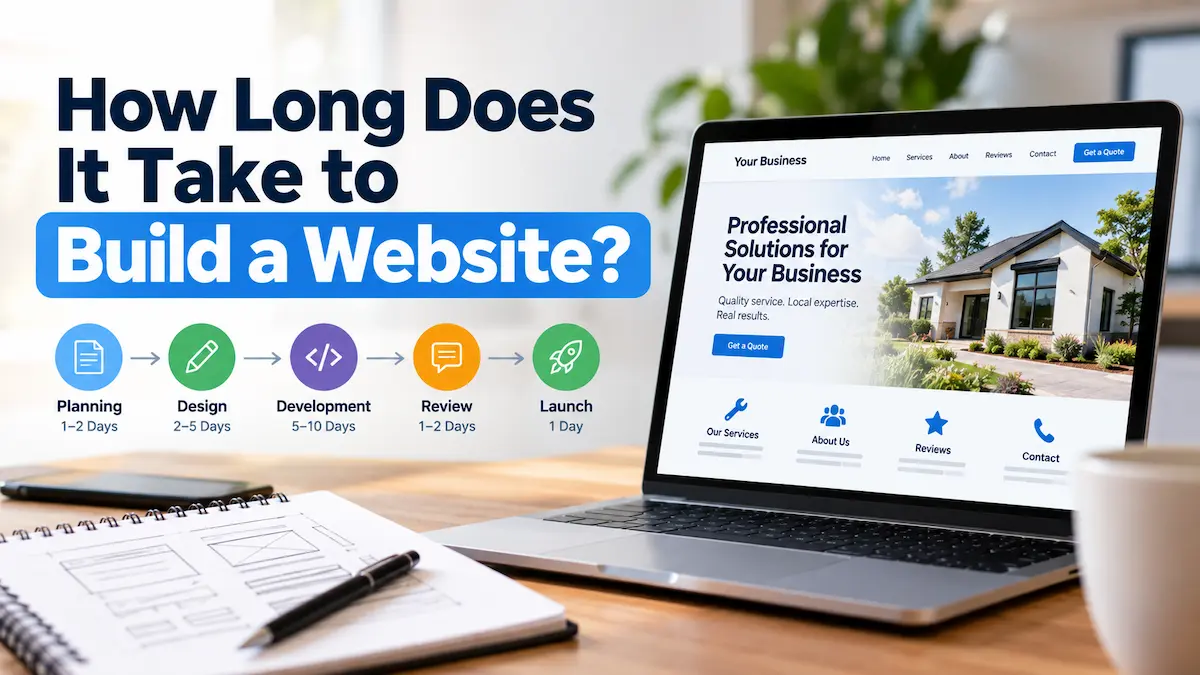
A typical small business website takes 2 to 4 weeks from providing your information to launch. A simple website can be completed faster, while larger websites with e-commerce, custom functionality, integrations, or extensive content can take several weeks or months.
For a straightforward small business website, the biggest factor is often not development time. It is how quickly the business provides content, images, feedback, and approvals.
At GetOwnWeb, most custom small business websites take about 2 to 3 weeks from the time you provide your details to the finished, live website. The build itself is typically completed in 5 to 10 days, followed by a review and revision period.
Website development timeline at a glance
| Website type | Typical timeline |
|---|---|
| One-page website | 2 days to 1 week |
| Small business website | 2 to 4 weeks |
| Custom business website | 3 to 8 weeks |
| E-commerce website | 4 to 12+ weeks |
| Custom web application | 2 to 6+ months |
These are practical ranges rather than fixed deadlines. The number of pages, functionality, content, design requirements, integrations, and approval process can all change the schedule.
How long does a small business website take?
For most local businesses, a professional website with around 5 to 10 pages can usually be completed in 2 to 4 weeks. A typical project might include:
- Home
- About
- Services
- Individual service pages
- Reviews or testimonials
- Service areas
- Contact
- Privacy policy
- Blog
If the content and images are ready at the beginning of the project, the process can move considerably faster. That is also roughly what a five-page site costs less to build, since less content and design work is involved; see our guide to small business website cost for the pricing side of this.
GetOwnWeb's process is designed around this approach. You provide your business information and requirements, the website is designed and built, you review the completed site, request changes, and then it is launched, ready for review in approximately 2 to 3 weeks depending on the project and content.
What happens during a website build?
A website does not go directly from an idea to a finished homepage. Several steps happen between the initial request and launch.
1. Planning and content
Typical time: 1 to 2 days. The first step is understanding the business, its services, customers, location, goals, and required pages. You may need to provide:
- Business name and contact information
- Logo and brand assets
- Service descriptions
- Photos
- Testimonials
- Service areas
- Preferred website examples
- Existing website details
Having these materials ready can remove days or weeks of waiting.
2. Design and development
Typical time: 5 to 10 business days. This is where the actual website is designed and developed. The work may include:
- Page layouts
- Responsive design
- Navigation
- Mobile optimization
- Contact forms
- Service pages
- Calls to action
- SEO-friendly page structure
- Performance optimization
- Technical setup
3. Review and revisions
Typical time: 1 to 2 days. Once the website is ready, you review it and identify anything that needs changing. For example, you might request:
- Copy changes
- Image replacements
- Layout adjustments
- New information
- Button changes
- Contact details
- Additional minor sections
A clear, consolidated list of feedback usually makes this stage faster.
4. Launch
Typical time: 1 day. Before launch, the website should be checked across phones, tablets, and desktop screens. Important launch checks include:
- Forms work correctly
- Phone numbers are clickable
- Links work
- Pages load correctly
- Images display properly
- HTTPS is enabled
- Mobile layouts work
- Metadata is present
- Analytics are configured where needed
- Search engine indexing can occur
After these checks, the website can go live.
What can make a website take longer?
The development process is only one part of the timeline. Several factors can extend a project.
1. Content is not ready
Waiting for website copy, photos, service information, or testimonials is one of the most common sources of delay. If the designer has to wait for five pages of content, the development schedule can stall even if the technical work is ready.
2. Too many decision-makers
A website becomes slower to launch when several people need to approve every page. For a small business, having one person responsible for collecting and approving feedback can make the process much more efficient.
3. Large numbers of pages
A 5-page website and a 30-page website are very different projects. More pages mean more content, design, development, internal links, SEO work, images, and quality checks.
4. Custom functionality
A standard business website is relatively straightforward. Custom features can add significant development time, including online booking, membership systems, customer dashboards, advanced calculators, custom databases, third-party integrations, complex forms, e-commerce, and web applications.
5. Revisions
A project with one focused review cycle can move quickly. Multiple rounds of major design changes can extend the timeline considerably.
How long does an e-commerce website take?
An e-commerce website generally takes longer than a standard business website because it requires additional functionality. An online store may need:
- Product pages
- Categories
- Shopping cart
- Checkout
- Payment processing
- Shipping rules
- Taxes
- Customer accounts
- Order management
- Product images
- Inventory configuration
- Transaction testing
A small, straightforward store might take 4 to 8 weeks, while a larger store with hundreds of products, custom functionality, or multiple integrations can take considerably longer.
How long does it take to build a custom website?
A highly customized website can take 3 to 8 weeks or more. The word "custom" matters here. A custom website is not necessarily slow to build, but additional design and functionality require more planning and testing.
A custom web application is a different category altogether. Applications involving accounts, databases, dashboards, APIs, payments, or complex business logic can take several months.
What is the fastest way to build a website?
The fastest way to launch a professional website is to keep the initial scope focused and have your content ready before development begins. To reduce delays:
- Decide which pages you actually need.
- Prepare your business information.
- Collect your logo and photos.
- Prepare or approve your website copy.
- Choose one person to provide feedback.
- Keep revisions focused.
- Avoid adding major features during development.
- Make sure your domain and hosting information are available.
For many small businesses, a focused website is enough to establish an online presence and start generating leads without waiting months for a large project.
Does SEO make a website take longer to build?
SEO should be considered during the website build rather than added as an afterthought. A search-friendly website typically needs:
- Clear page structure
- Descriptive titles and headings
- Useful, original content
- Logical internal links
- Mobile-friendly pages
- Fast-loading pages
- Accessible content
- Relevant local information
- Search-friendly URLs
- Proper technical configuration
Google's current guidance says the fundamentals of SEO remain relevant for its AI-powered search experiences, including AI Overviews and AI Mode. Google also emphasizes useful, original, people-first content rather than content created primarily to manipulate rankings.
SEO and GEO should be part of the website's structure from the beginning, not something bolted on after launch.
What is GEO and why does it matter?
GEO, or Generative Engine Optimization, refers broadly to making information easier for AI-powered search experiences to understand, retrieve, and cite. If you want the full breakdown, read our guide to SEO vs GEO.
There is no special "AI ranking trick" that guarantees inclusion in Google's AI results. Google specifically says there are no additional technical requirements or special optimizations required for AI Overviews or AI Mode. Instead, standard SEO fundamentals continue to matter. Useful GEO practices include:
- Answering common customer questions directly
- Using clear headings and concise explanations
- Providing specific facts about services and locations
- Demonstrating first-hand expertise
- Publishing original, useful information
- Keeping business information consistent
- Creating content that genuinely helps customers
Google's 2026 guidance for generative AI search also emphasizes valuable, unique, non-commodity content.
How long does a website take to start ranking on Google?
Website development and Google rankings are two different timelines. A website can be built and launched in a few weeks, but ranking in Google is not guaranteed on a specific schedule. How quickly a website gains search visibility depends on factors such as:
- Competition
- Location
- Search demand
- Website quality
- Content
- Backlinks and mentions
- Technical SEO
- Business reputation
- Existing domain history
Launching the website is the beginning of the SEO process, not the end.
How long does it take to build a website with GetOwnWeb?
Most business websites take approximately 2 to 3 weeks from receiving the necessary business details to launch, with the exact timeline depending on the number of pages and how quickly feedback is provided. Our process is intentionally simple:
Tell us about your business → We build the website → You review it → We make changes → You approve it → We launch it.
Every website is built with an SEO-ready structure, responsive across devices, and delivered with full ownership of the website, code, content, files, hosting, and domain. See current pricing for what is included.
Final answer: how long should you expect?
For most small businesses, 2 to 4 weeks is a realistic website development timeline. A simple website may take only a few days. A standard business website generally takes a few weeks. E-commerce websites and custom web applications can take considerably longer.
The fastest projects are not necessarily the ones with the fewest development hours. They are usually the projects with a clear scope, ready content, fast decisions, and a straightforward approval process.
If you are looking for a website without months of meetings and complicated processes, GetOwnWeb offers a simple email-first process for small businesses, with most websites completed in roughly 2 to 3 weeks and full ownership transferred to the business after launch. See how it works.
Frequently asked questions
How long does it take to build a website?
A typical small business website takes about 2 to 4 weeks from providing your information to launch. Simple sites can be faster; e-commerce and custom builds take longer.
How long does a small business website take?
A focused small business website of around 5 to 10 pages usually takes 2 to 4 weeks, assuming a clear scope and prompt content and feedback from the business.
Can a website be built in one week?
Yes. A simple website with limited pages, ready-to-use content, and minimal custom functionality can potentially be completed within a week. More typical small business websites take around 2 to 4 weeks.
How long does an e-commerce website take?
A small, straightforward store might take 4 to 8 weeks. A larger store with hundreds of products, custom functionality, or multiple integrations can take considerably longer.
What is the biggest cause of website delays?
For many small business projects, delays come from missing content, slow approvals, added requirements, or repeated revisions rather than the development work itself.
How can I launch my website faster?
Have your content, images, logo, page list, and business information ready before development begins, keep the scope focused, and respond to revision requests quickly.